US-China Rare Earth Deal — Implications for Global Trade & India
US-China Rare Earth Deal — Implications for Global Trade & India
Introduction
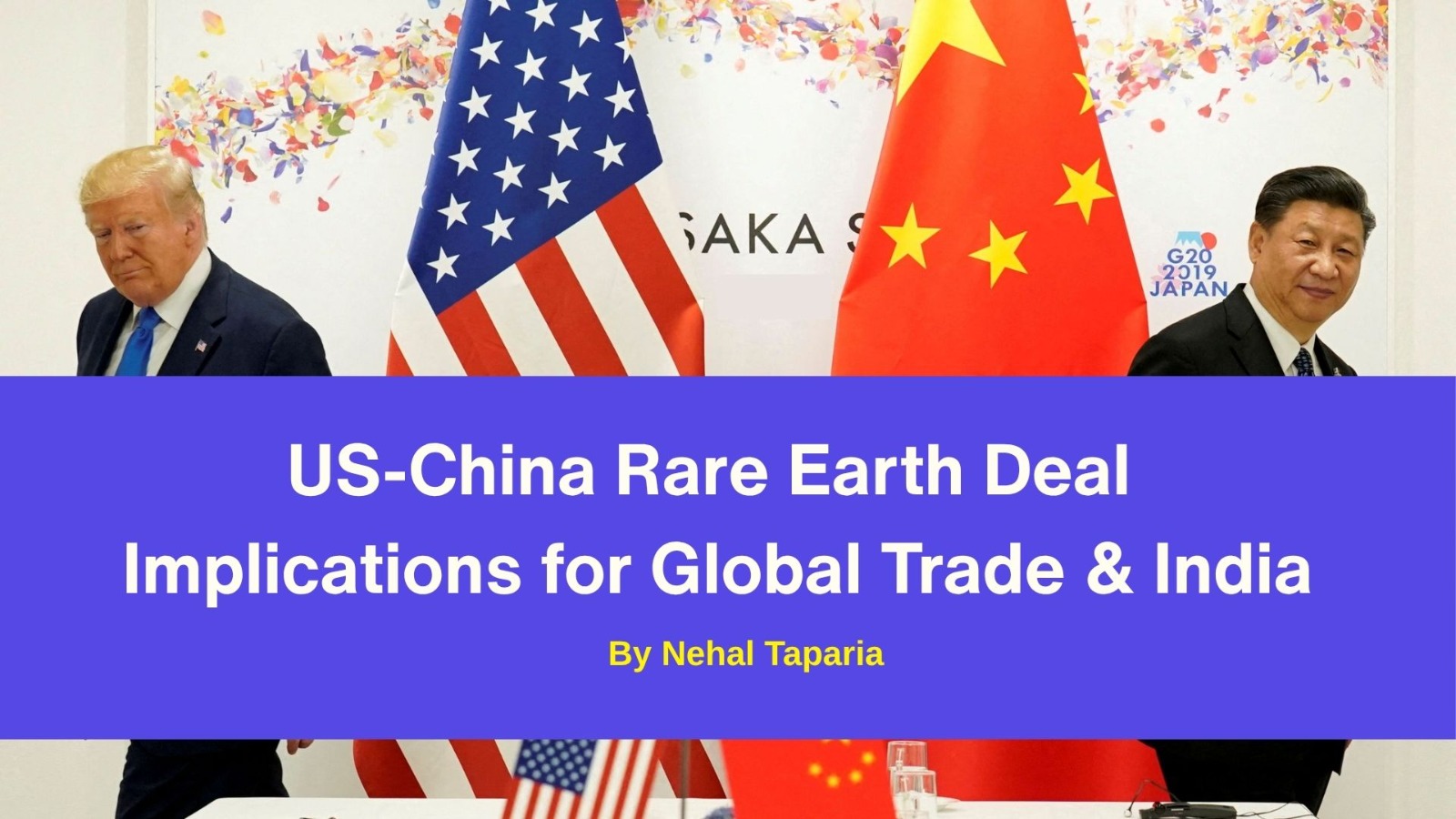
On October 30, 2025, Donald Trump (US President) and Xi Jinping (Chinese President) announced that they have clinched a deal on rare earths. The agreement reportedly ensures continued flows of rare earth elements (REEs) from China to the US, in exchange for tariff reductions and other trade / policy concessions. It appears to be a one-year deal, subject to renegotiation annually.
Rare earths are critical commodities used in high-technology, defense, renewable energy, electronics, magnets, batteries, etc.
This development could reshape supply chains, trade balances, geopolitical alignments, and price dynamics for many countries — including India.
Key points of the deal (or what’s known so far)
- The deal was struck amidst trade tensions: China had imposed export curbs on various rare earth metals; there were accusations of restrictions for defense / high tech / AI / dual-use applications.
- The US had threatened high tariffs on Chinese goods, including raising tariffs to as high as 100% in response.
- Under the new arrangement, China will supply magnets and rare earth minerals (including rare earths needed for critical industries).
- Meanwhile, the US has offered concessions, including tariff adjustments and non-trade aspects (e.g. China students, etc.).
- The deal is for one year, and presumably will be renegotiated.
- Global markets responded positively: relief in markets and supply chain concerns were somewhat eased.
Implications & Analysis
Here I discuss what this could mean for India (economy, markets, sectors) + globally.
Global & supply chain impact
- China has been one of the dominant players in rare earth extraction, processing, refining, and export. It previously imposed export controls, especially on certain rare earths important for defense, AI / semiconductor / dual-use industries.
- This deal may ease export controls or ensure more predictable supply of rare earths to the US and perhaps other countries, reducing supply risk (at least for the US / its allies).
- That could reduce volatility in prices of rare earth elements, or reduce risk of supply shocks for industries depending on them.
Impacts on India
Since you are likely interested in how the Indian market / economy might react (especially given your interest in finance / markets), here are some thoughts:
1. Raw material / upstream / mining sector
- India actually has significant rare earth reserves. According to public data, India ranks among countries with large reserves of rare earth elements (in mineral sand deposits, etc.).
- The country has been trying to ramp up exploration / mining / processing — e.g. coastal sands, hard rock in some states, etc.
- This means India is not entirely dependent on China for rare earth sources (at least in terms of reserves), though its processing / refining infrastructure and technology may still be less advanced.
- The deal between US and China might reduce some price pressures or supply constraints globally; so domestic producers in India could face more competition or reduced margins if global supply loosens.
2. Manufacturing / high tech / electronics / defense & renewable / EV sectors
- Many industries in India (electronics, defense manufacturing, renewable energy — wind, solar with magnets, EV motors, batteries, etc.) rely on rare earth inputs (magnets, etc.).
- If supply becomes more stable globally, maybe import costs of rare earths may become more stable or even fall (if supply increases or uncertainty reduces). That could help Indian manufacturers by stabilizing input costs.
- However, if the global supply becomes loosened (via China exporting more or relaxing controls), global competition might intensify for Indian firms that want to export or build value chain capabilities.
3. Trade & diplomacy
- India is in a complex diplomatic position between US, China. India has trade / border / policy friction with China; also trade relations with US.
- The US-China deal might shift global leverage; the US might rely less on alternative sources; China might feel less pressure; or might use other levers on other partners.
- There could be opportunities for India to negotiate with US or supply to allied / global value chains for rare earth processing or value addition.
4. Financial markets & investor sentiment
- Share prices of Indian mining / mineral companies or rare earth / mining / technology / EV supply chain firms may respond to global supply chain shifts.
- If rare earth input costs reduce or become more stable, margins of downstream firms (EV, motor / wind turbine / electronics) might improve or become more predictable.
- Conversely, if global competition intensifies or if China exports a lot, price reduction globally might reduce margins for Indian upstream exploration/mining.
5. Risks & opportunities
Opportunities
- India can accelerate its own exploration & refining capabilities, position as alternative / value addition hub.
- Indian policy makers can push for domestic capacity (mining + processing + refining + R&D).
- Indian firms could partner with US / other allied countries who want alternatives to Chinese supply.
Risks
- If China opens up supply, global supply may flood, lowering prices, hurting domestic producers or exploration in India.
- Dependence on imported rare earth or processing technology remains a challenge; India must build capacity to benefit fully.
- Geopolitical shifts: if US becomes less dependent on alternatives, India may lose negotiation leverage to attract investments.
How it will impact the Indian market (short / medium / long term)
|
Time horizon |
Possible impact on Indian market / economy / sectors |
|
Short term (0-6 months) |
Some easing of input cost pressure for industries reliant on rare earth imports. Market / investor sentiment might improve due to global supply stability. Mining / exploration firms may face some uncertainty if global supply loosens. |
|
Medium term (6-18 months) |
Domestic mining / processing firms may accelerate capacity. EV / renewable / electronics sectors may get more certainty in raw material inputs, improving project viability. Investors may see more clarity in cost structures. |
|
Long term (2+ years) |
India may emerge as alternative value-chain player in rare earth extraction / processing. Policy push could create local refining / processing ecosystems. Indian firms might compete globally or supply to allied markets. Domestic sectors like EV, defense, renewables may benefit from lower reliance on imports or more stable supply chains. |
Conclusion
This deal between the US and China on rare earths could be a turning point in global supply chains. For India, it is both a challenge and an opportunity. On one hand, stable supply globally might reduce costs and uncertainties for industries dependent on rare earths. On the other, India needs to accelerate capacity building in mining, refining, and processing to fully capture the opportunity.
By Nehal Taparia
This content is for educational and knowledge purposes only and should not be considered as investment or Trading advice. Please consult a certified financial advisor before making any investment or Trading decisions.
Latest Course





Latest posts




Our Recent FAQS
Frequently Asked Question &
Answers Here
Q1: What exactly are rare earths?
Rare earth elements (REEs) are a group of 17 chemical elements including lanthanides plus scandium and yttrium, used in high-technology applications: magnets, electronics, renewable energy, EV motors, semiconductors, defense equipment, AI / high tech.
Q2: Why is this US-China deal significant?
Because China had imposed export controls on various rare earths and related materials, which disrupted global supply chains. The US threatened large tariffs or trade retaliation. The deal signals a détente: China agrees to supply rare earths and the US offers tariff reductions.
Q3: Will this benefit India?
Potentially yes. India has significant rare earth reserves and is trying to build local capacity. If global supply stabilizes, input costs for Indian industries may become more predictable. But the full benefit depends on how fast India builds refining/processing capacity and how global prices evolve.
Q4: What sectors in India will be most impacted?
• Mining / exploration firms working on rare earth / mineral sands or hard rock deposits.
• Downstream manufacturing: EV motors, permanent magnets, electronics, renewable energy (wind turbines, solar, battery technologies), defense manufacturing.
• Export / value chain industries that rely on rare earth inputs.
Q5: Could there be negative consequences?
• If global supply from China increases sharply, rare earth prices may drop, affecting profitability for Indian upstream explorers.
• Indian firms still need technology, refining know-how; lag in processing capacity may limit benefits.
• Geopolitical / trade shifts might reduce India’s leverage in negotiations.
Q6: What should investors / policymakers in India watch for?
• Updates on domestic policy: exploration licenses, refining capacity, technology transfers, incentives for rare earth processing.
• Price trends for rare earth elements globally.
• Performance of Indian mining / rare earth companies.
• Demand in downstream sectors (EV, renewable, electronics).
• Trade / diplomatic developments with US / China / other countries.
Copyright © By The Stock Learning. Design & Developed by Techno Duniya